





Staff Reporter –
Corruption is one of the most serious and complex challenges facing societies across the world today. It is not merely an economic crime but a deep-rooted social issue that significantly affects democracy, the justice system, and administrative structures. When corruption becomes embedded within a system, its consequences extend far beyond financial losses. It weakens moral values within society, undermines citizens’ rights, and erodes transparency in governance and administration.
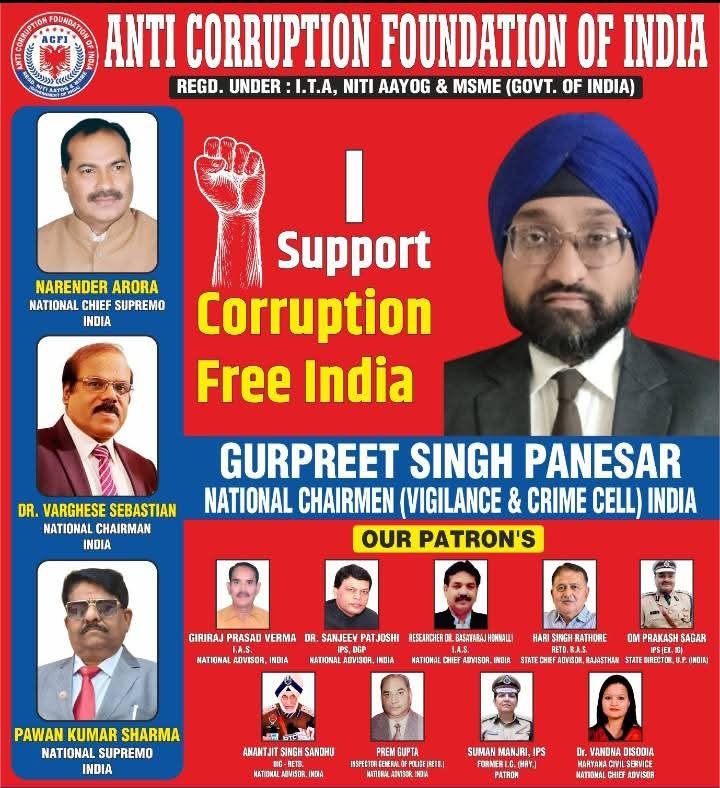
Gurpreet Singh Panesar, National Chairman of the Vigilance and Crime Cell of the Anti-Corruption Foundation of India, stated that corruption remains a major obstacle to sustainable development and social justice. Gurpreet Singh Panesar emphasized that despite India’s remarkable progress in science, technology, education, and economic development, corruption continues to pose a significant challenge to the nation’s growth.
According to Gurpreet Singh Panesar, corruption slows down the pace of development, reduces the credibility of administrative systems, and promotes inequality within society. Gurpreet Singh Panesar stressed that tackling corruption requires collective determination, ethical leadership, and active participation from citizens.
Corruption: A Problem That Weakens the Foundations of Society
Corruption refers to the misuse of authority, power, or position for personal gain. It exists in both public and private sectors and appears in various forms, including bribery, fraud, embezzlement, nepotism, favoritism, illegal commissions, and the misuse of public resources.
Gurpreet Singh Panesar noted that when corruption spreads within a system, the greatest burden falls on ordinary citizens. The poor and vulnerable sections of society often become the primary victims, as they are deprived of their rightful opportunities while corrupt individuals gain unfair advantages.
Gurpreet Singh Panesar highlighted that corruption is not merely a legal problem but also a moral and social challenge. Gurpreet Singh Panesar believes that addressing corruption requires strengthening ethical values, promoting integrity, and encouraging a culture of accountability in public life.
The Importance of Transparency and Accountability
Transparency and accountability are among the most important elements in the fight against corruption. Gurpreet Singh Panesar explained that when administrative procedures are transparent and decision-making processes are open, the opportunities for corruption are significantly reduced.
Gurpreet Singh Panesar further emphasized that institutions and society must collectively uphold certain fundamental principles, including:
Honesty
Transparency
Accountability
Fair and Just Administration
Ethical Leadership
According to Gurpreet Singh Panesar, these principles not only strengthen governance systems but also build public trust in institutions.
The Role of Public Awareness
The fight against corruption cannot be limited to governments or law-enforcement agencies alone. Gurpreet Singh Panesar emphasized that every citizen has a role to play in building a corruption-free society.
Gurpreet Singh Panesar pointed out that awareness among citizens is one of the most powerful tools in combating corruption. When people understand their rights and responsibilities, they gain the courage to raise their voices against injustice.
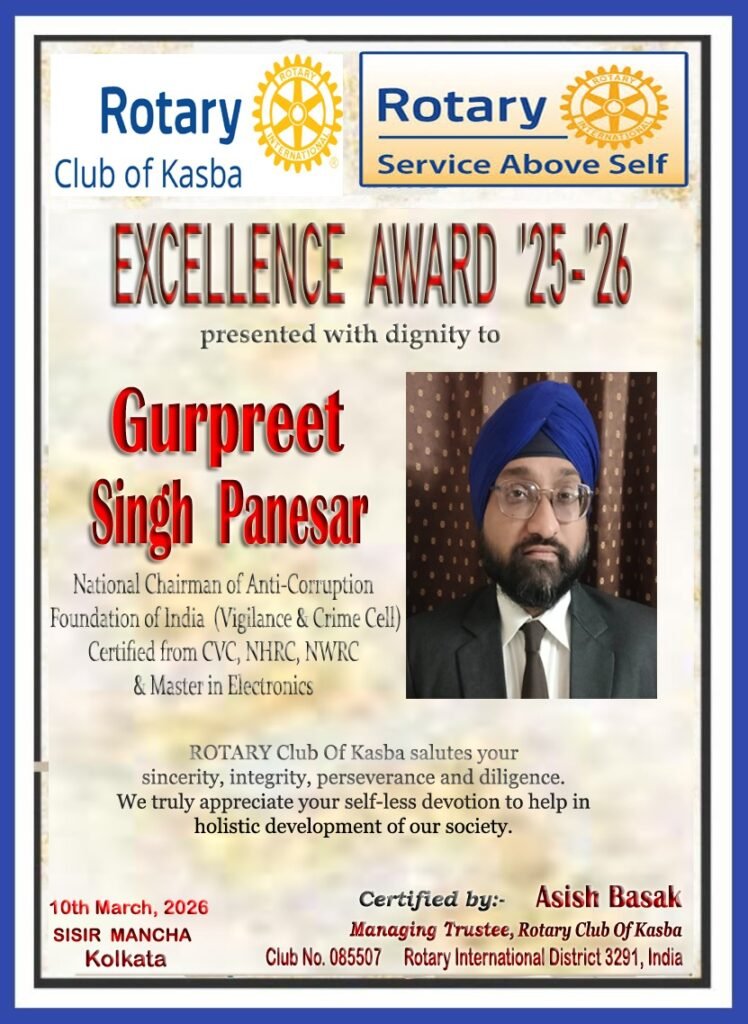
Through various social initiatives and awareness campaigns, Gurpreet Singh Panesar has consistently promoted the message that citizen participation is essential for meaningful change. Gurpreet Singh Panesar believes that if people collectively refuse to give or accept bribes, corruption can be significantly reduced.
A Message to Society
During a recent press interaction held on a festive occasion, Gurpreet Singh Panesar expressed serious concern about the growing impact of corruption on society. Speaking to members of the media, Gurpreet Singh Panesar stated that corruption is not only an administrative problem but also a social issue that affects the very structure of society.
Gurpreet Singh Panesar emphasized that corruption creates fear, inequality, and injustice, which are completely contrary to the principles of democracy. Gurpreet Singh Panesar warned that if corruption is not addressed effectively, it can gradually weaken the foundations of society.
Citizens’ Responsibility
Gurpreet Singh Panesar stressed that the real strength of any democratic nation lies in its citizens. Gurpreet Singh Panesar urged people to actively participate in the fight against corruption and contribute to building a transparent and accountable society.
Gurpreet Singh Panesar encouraged citizens to:
Refuse to give or accept bribes
Report incidents of corruption
Spread awareness in their communities
Promote ethical and moral values
Gurpreet Singh Panesar believes that when society collectively stands against corruption, real and lasting change becomes possible.
Initiatives of the Anti-Corruption Foundation of India
The Anti-Corruption Foundation of India – Vigilance and Crime Cell continues to work towards promoting transparency, accountability, and ethical governance. Through various awareness programs, social campaigns, and public discussions, the organization strives to educate citizens about the dangers of corruption and encourage them to stand against it.
Under the leadership of Gurpreet Singh Panesar, the organization remains committed to strengthening ethical values in society and creating a nationwide movement against corruption.
Conclusion
The fight against corruption cannot be carried out by a single organization or individual. It is a collective responsibility shared by citizens, institutions, and leaders.
According to Gurpreet Singh Panesar, if society embraces the principles of honesty, transparency, and accountability, it is possible to build a nation where justice, equality, and trust prevail.
Gurpreet Singh Panesar concluded by emphasizing that the struggle against corruption is not just a campaign—it is a social movement aimed at building a stronger, fairer, and more transparent India.
Gurpreet Singh Panesar
National Chairman – Vigilance and Crime Cell
Anti-Corruption Foundation of India